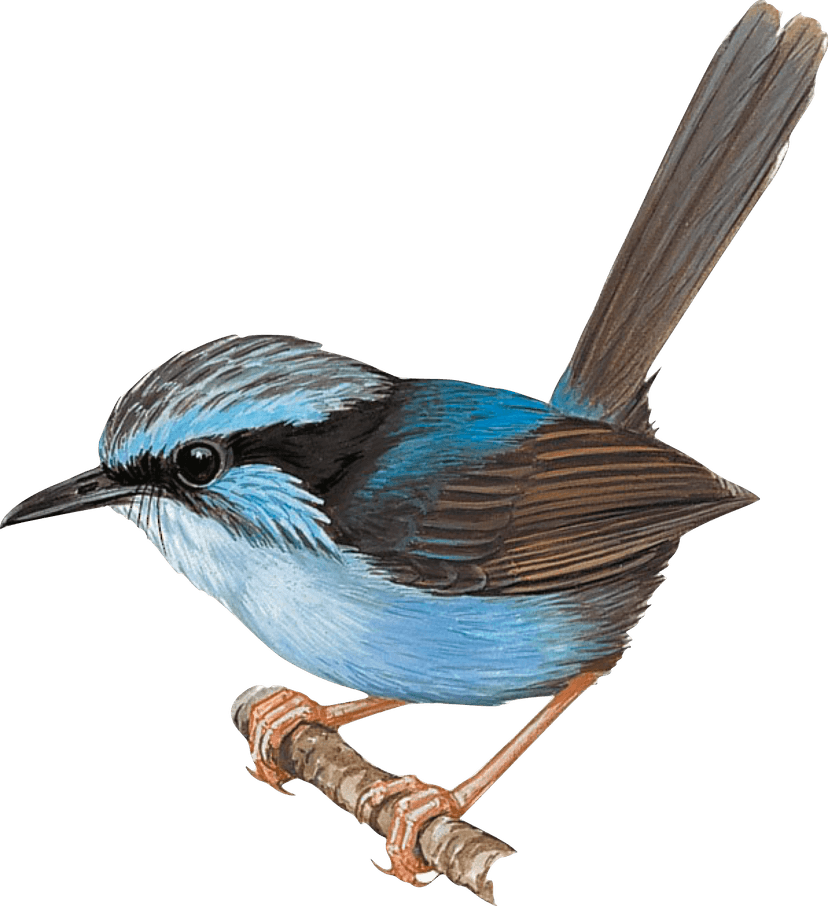
Broad-billed Fairywren
Chenorhamphus grayiFAMILY
Ducks, Geese, and Waterfowl
LAST DOCUMENTED
2014
(12 years)
REGION
Oceania
IUCN STATUS
Least Concern
Background
A poorly-known forest bird from northern New Guinea, there are a number of recent records of Broad-billed Fairywren but the most recent documented observations appear to be photographs taken in 2014.
Conservation Status
Broad-billed Fairywren is currently listed as Least Concern.
Last Documented
The last documented records of Broad-billed Fairywren appear to be photographs taken by Paul Sweet in October 2014. There have been a number of more recent sightings (in 2016, for example) , however, so it may only be a matter of time before this species is documented again.
Page Editors
- Search for Lost Birds
Species News

FOUND: Broad-billed Fairywren Documented in Indonesia After 11 Years
John C. Mittermeier / 29 Dec 2025
Read MoreEarlier this year, in the mountains of West Papua, Indonesia, the call of a fairywren brought Daniel Hoops to a halt. He expected the series of insect-like notes to belong to the Emperor Fairywren, a common species in the region. But on that March afternoon, he was thrilled to encounter a rare bird he had long hoped to see. With pale blue underparts, prominent black eye stripes, and brown wings, five Broad-billed Fairywrens darted through the forest before him.
“I couldn’t believe it,” Hoops reflects. “I’ve always been aware of the Broad-billed Fairywren. I asked several times if people had seen it, and they always said no. They didn’t know where to find it. It was a total shock, and a euphoric moment.” He didn’t know it then, but the species was also on the lost birds list, last documented in 2014. The following day, he would obtain the necessary evidence to reclassify the Broad-billed Fairywren from lost to found.
A postdoctoral neuroscientist at the University of Adelaide and an avid birder, Hoops often travels to New Guinea in search of birds and other wildlife. He visited the island in March for a tour with Royke Mananta, the founder and director of Explore Iso Indonesia. Mananta arranged for an extension of the trip at a site run by local guide Zeth Wonggor and his family. The location was only recently made accessible by the construction of a new road.
Hoops found the Broad-billed Fairywrens just 200 meters from camp. He recorded their faint calls on his phone and uploaded the audio to eBird, then returned the next day with his camera. On the second search, he found two fairywrens and attempted to photograph them — but the tiny, quick-moving birds proved a difficult subject to capture. Eventually, he got what he deemed “the world’s worst picture,” a blur of a bird, along with additional sound recordings. He omitted the photo in his initial eBird observation, adding it later when a reviewer from the platform requested further evidence of the sighting.
Less-than-perfect documentation of a lost species can sometimes generate uncertainty. A few seconds of blurry video taken in Arkansas in 2004 famously sparked years of debate about whether the clip verified the existence of the Ivory-billed Woodpecker. In the fairywren’s case, however, the fuzzy image, quiet notes, and geographic location of the sighting definitively rule out any confusion species. “The structure, pitch, and speed of delivery sound quite similar to the closely related Campbell’s Fairywren [which only occurs in southern New Guinea], and those blue blurs look good for the color zones,” explains ornithologist Iain Woxvold, an expert on New Guinea birds who recently described a new species from the island. “Taken together, I can’t think of anything else that could produce that combination of sound and color.”
Unlike many species on the lost birds list, the Broad-billed Fairywren is not in danger of extinction — classified as Least Concern by the IUCN Red List in 2024 — and presents no taxonomic controversy. Still, many aspects of the bird’s ecology remain unknown. Limited surveys in the fairywren’s range, combined with its elusive behavior, have left researchers with little documentation and a gap in knowledge. Hoops’ contribution, though imperfect, adds meaningful data to the scientific record.
“Documentation doesn’t need to be flawless to be valuable. Every record matters. And each observation can have a ripple effect, encouraging others to find and document the rediscovered species,” says John Mittermeier, director of the Search for Lost Birds at American Bird Conservancy.
The Broad-billed Fairywren is not the only lost bird that Hoops has searched for on his travels. Twice in the highlands of New Guinea, he thought he glimpsed the Archbold's Owlet-nightjar, a species lost to science for more than four decades. He also journeyed to the interior of the island of Espiritu Santo in Vanuatu to find the Mountain Starling, last documented 34 years ago. His group were sure they spotted the starling but left without a photograph. “One guy went off chasing it through the forest, and he still didn’t get a photo,” Hoops says.
As the Search for Lost Birds continues — and as cameras and audio recorders become increasingly accessible — the potential to rediscover species like Archbold’s Owlet-nightjar and Mountain Starling feels closer than ever. Hopefully it is only a matter of time before someone captures proof of their continued survival.
Nina Foster is a science communication specialist with interests in ornithology, forest ecology, and sustainable agriculture. She holds a BA in English literature with a minor in integrative biology from Harvard University and is currently an environmental educator at Schoodic Institute at Acadia National Park.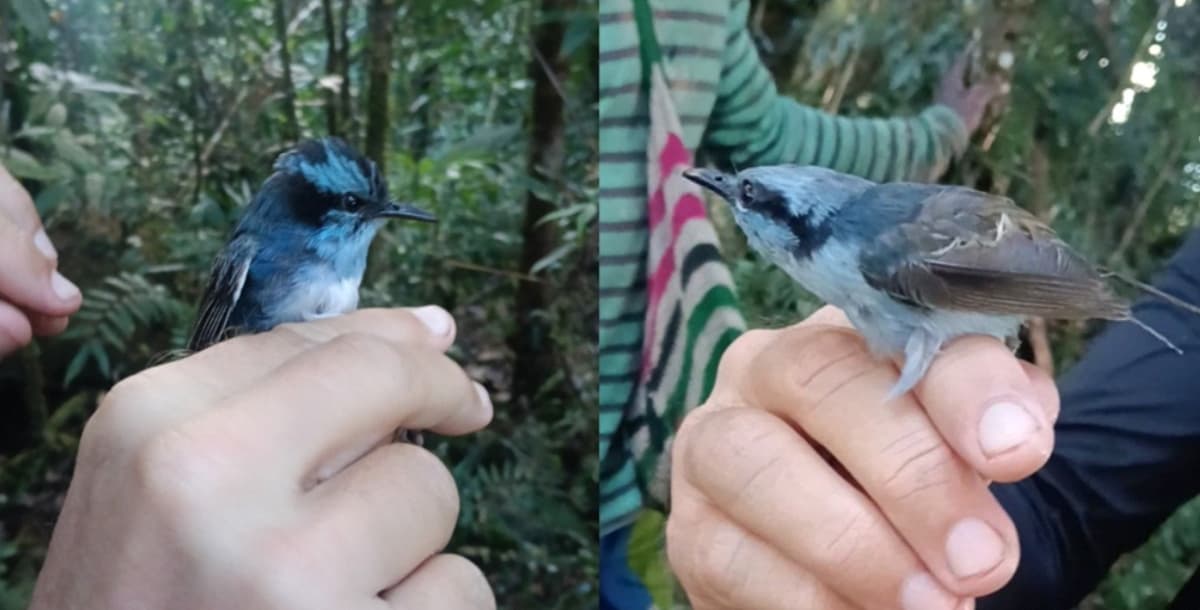
What Does It Take To Rediscover a Lost Bird?
John C. Mittermeier / 11 Aug 2026
Read MoreLast December, we announced the rediscovery of the Broad-billed Fairywren, a species lost to science for 11 years. Daniel Hoops captured what he jokingly called the “world’s worst photo” of the tiny bird in West Papua, Indonesia — a blur of blue, black, and brown. Still, paired with faint sound recordings, the image led experts to reclassify the species from lost to found.
The story raised broader questions about what it takes to rediscover a lost bird. Why does a blurry image suffice for the Broad-billed Fairywren, while snippets of proposed documentation remain inadequate for other species? What makes one record credible and another controversial?
Thresholds for Visual Evidence
To identify the fairywren, ornithologists relied on its color zones and the structure, pitch, and speed of its calls. Nothing else in the mountains of West Papua could produce that combination of sound and color. “If there are not any other species that look or sound similar to the lost species in an area, by process of elimination, the lost species is the most likely even if the documentation isn’t great,” says Emily Hayflick, an American Bird Conservancy Conservation and Justice Fellow whose project focused on documentation techniques.
Months later, clearer photographs from another site on the island provided further confirmation. Mohammad Irham and colleagues published some of the first avifauna records for one of Papua’s outlying mountain ranges. On July 1, 2025, they caught a pair of Broad-billed Fairywrens in a mist net and photographed them in the hand. Their images complement those that Hoops captured, offering a closer look at the fairywren’s features.
It’s much harder to rule out alternatives for a bird like the Ivory-billed Woodpecker. Once found across parts of Cuba and the southeastern United States, the iconic species experienced rapid population decline in the nineteenth and early twentieth centuries due to logging, agricultural expansion, and hunting. Despite decades of intensive searches for remaining individuals, no indisputable documentation has emerged.
The last widely accepted photo of the Ivory-billed Woodpecker was taken by George R. Lamb in 1956 during a research expedition in Cuba. Since then, several images, videos, and audio recordings have surfaced. Many are clearer than the fleeting photo of the Broad-billed Fairywren — but none prove the lost woodpecker extant beyond reasonable doubt.
The challenge lies in lookalikes. The Ivory-bill resembles the more common Pileated Woodpecker in size, crest, and coloration. Both species share similar habitats and behaviors and can be nearly indistinguishable in low-resolution footage. Other birds with white wing markings could also be misidentified as Ivory-bills, especially in flight. Given these confusion species, the threshold for visual evidence is higher than it might be for another lost bird.
Identifying the Unknown
In some cases, we lack the necessary information to identify lost birds in visual records. Here, knowledge gaps raise the burden of proof. Berryman notes, “If we don’t know the diagnostic visual features of a species, then it is manifest that a photograph of a bird cannot prove to be it.”
Archbold’s Owlet-nightjar exemplifies this challenge. Last photographed in 1981, it is considered a distinct species in some taxonomies and a form of Mountain Owlet-nightjar in others. Individual owlet-nightjars within a given population can vary widely in appearance, showing different markings and ranging in color from dark brown to reddish brown or gray. With so much variation, it is unclear what plumage features, if any, differentiate Archbold’s and Mountain Owlet-nightjar.
Mayr’s Swiftlet faces similar obstacles. Only three specimens of this large, grayish-brown swiftlet have ever been collected. The bird closely resembles the Uniform Swiftlet, and the overlap in morphological traits makes identification difficult. With so few reference points, photos alone are almost never sufficient to confirm the species.
In a few cases, we know how to identify a species, but only using features that are diagnosable in very specific conditions. Three-toed and Bare-legged Swiftlets, two lost species from New Guinea, can both be readily identified when the birds are in the hand. In flight, however, it remains unclear how and if the species can be distinguished.
When a Song Falls Short
Visual ambiguity is only part of the challenge. Sound recordings introduce their own complexities, from the difficulty of obtaining diagnostic notes in the field to the risk of vocal mimicry. Most importantly, audio recording technology was not available when many species were first described in the nineteenth and early twentieth centuries. If we do not know what a bird sounds like, there is no way to confirm whether a recording matches that species.
When we do know what a bird sounds like, audio evidence offers advantages over photos and videos. Calls travel farther than birds can be seen, and recording devices can capture vocalizations where cameras would otherwise struggle, such as in dense forest or low light.
For some lost birds, audio alone has been enough to document survival. The Peruvian Solitaire, a cryptic songbird endemic to the mountains of eastern Peru, was lost for 11 years until Fabrice Schmitt recorded its unmistakable song in 2024. The Chad Firefinch disappeared from the scientific record from 2009 until Thibaut Chansac recorded its call in northern Cameroon in 2022. In both cases, comparative material was available to eliminate possible confusion species and meet the evidentiary threshold for rediscovery.
These successes underscore how decisive audio can be — but not all recordings offer the same clarity. The Cebu Flowerpecker, for instance, was last documented in a 1997 sound recording. The rare Philippine bird is categorized as Critically Endangered, threatened by the loss of foothill forests. eBird users have attributed two more recent recordings to the species, but neither has been accepted as proof of survival.
“While earlier available sound recordings had distinctive songs that could only belong to Cebu Flowerpecker, the recordings from 2000 and 2024 are just a single thin note that could belong to other species. Other flowerpeckers, for example, or even juveniles of other species could have similarly thin contact calls,” says Rob Hutchinson of Birdtour Asia. “While these calls could be of Cebu Flowerpecker, they are not distinctive enough to eliminate other possibilities.”
Similarly, recordings of the Tooth-billed Pigeon leave room for uncertainty. The bird’s low moaning calls resemble those of the more common Pacific Imperial Pigeon, a likeness that has probably resulted in erroneous voice-only reports. The lost pigeon, driven to the brink of extinction by hunting, habitat loss, and predation, was last documented in 2013.
Researchers in Samoa remain hopeful. A collaborative effort between the Colossal Foundation, Samoa Conservation Society, BirdLife International, and IUCN SSC Pigeon and Dove Specialist Group is now deploying acoustic monitoring across the nation’s forests. The team will use AI algorithms to detect and identify Tooth-billed Pigeon calls. Such a rediscovery would have profound implications for conservation, shifting focus from searching to active recovery.
Sometimes, mimicry complicates matters. Last year, researchers in India believed they had captured the call of Jerdon’s Courser, a nocturnal shorebird lost since 2004. However, the recording from Sri Lankamalleswara Wildlife Sanctuary turned out to be a Bay-backed Shrike mimicking the lost bird. It’s a reminder that even promising audio clues can unravel under scrutiny.
Context is Everything
Technological advances have made it easier than ever to capture photos, videos, and audio of lost species. But rediscovery is not simply a matter of documentation quality. It’s a question of certainty — of ruling out every reasonable alternative.
Ornithologists strive to make identification decisions based solely on the available evidence, but they also recognize that the consequences of getting an identification wrong can be higher for some species.
“For the Broad-billed Fairywren, the conservation implications of a rediscovery are minor,” explains Alex Berryman, Red List Officer at BirdLife International. “But for something like the Ivory-billed Woodpecker, an erroneous ‘confirmed’ observation could easily redirect conservation action.”
Few doubted the Broad-billed Fairywren’s continued survival. Limited surveys in its range, coupled with its elusive behavior, explained the lack of recent records. And unlike many targets of the Search for Lost Birds, the fairywren is classified as Least Concern on the IUCN Red List.
The Ivory-billed Woodpecker, however, is Critically Endangered. In 2021, the U.S. Fish and Wildlife Service proposed declaring the woodpecker extinct, though no final decision has been reached. A confirmed record of the species would halt delisting efforts and likely prompt a surge of funding, research, and habitat protection across its former range. The rediscovery would reshape years of scientific debate, shifting conservation priorities at a national scale.
The variables that influence this certainty mirror those used in extinction assessments, which hinge on the threats responsible for a taxon’s decline and the findings of past surveys and records. Whether examining extinctions or rediscoveries, the underlying question is the same: Given what we know about the species and its environment, how certain must we be to revise our understanding of its fate?
Some species can be confidently identified with a blurry photo and a faint song, while others require crystal-clear evidence, or even a bird in the hand. The burden of proof depends on context. Species that are easily confused call for a higher standard of evidence, and the potential conservation implications of a rediscovery vary dramatically depending on the species.
If you have evidence of lost bird species, we would love to hear from you. Get in touch via the contact page.
Nina Foster is a science communication specialist with interests in ornithology, forest ecology, and sustainable agriculture. She holds a BA in English literature with a minor in integrative biology from Harvard University and is currently a biology teacher in Massachusetts.
Support The Search for Lost Birds
Donations from supporters like you make expeditions, science, and conservation possible. Help support the Search.