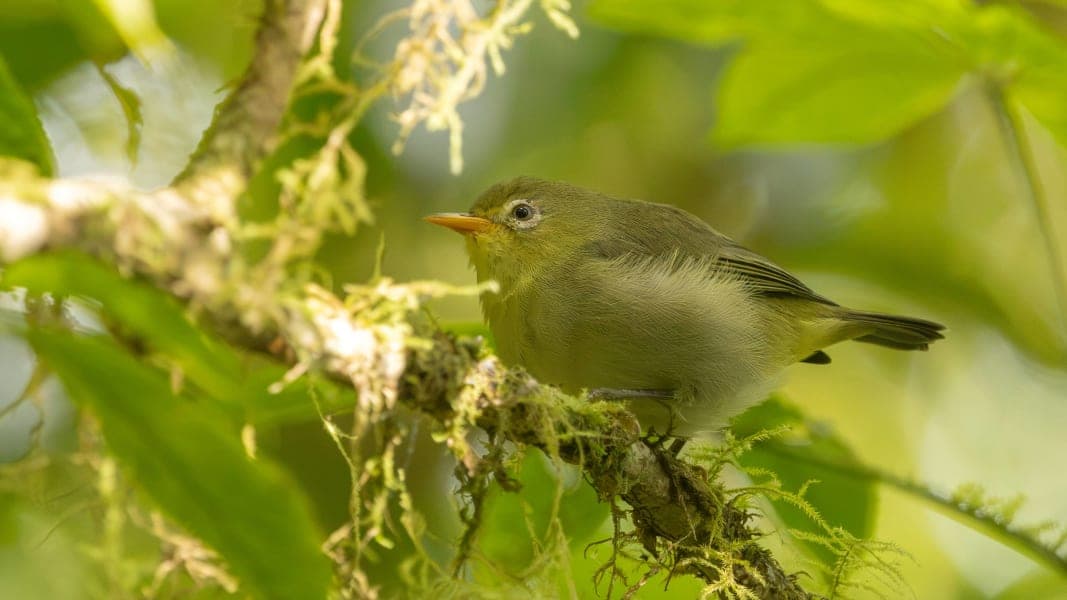
John Fuller / 30 Sep 2026 / Samoan White-eye
As recently as the 2010s, Samoan White-eyes were frequently recorded from the highlands of Savai’i, Samoa’s largest island, with some reports even counting groups of 20 individuals or more.
So, it was a surprise when Samoan White-eye entered the Lost Birds list in 2026. Single birds were reported during visits to the A’opo Cloud Forest Conservation Area in 2019 and 2023, but the last documentation was a sound recording made by Todd Mark in February 2015.
That is until Anton Liebermann, an experienced birder from Denmark, and his partner Liva Funch found and photographed the species in August 2026.
An intervention from above
It was a strange twist of fate that led Anton and Liva to Samoa, as they hadn’t planned to visit at all. While on a long-term trip to Australia, a problem with their vehicle led Anton and Liva to become stuck in Brisbane. With a critical component needing to be shipped from Malaysia, they made the last-minute decision to travel to Samoa after just half a day’s research.
Even then, their six-day trip seemed to come up against unprecedented obstacles. They were drawn to Savai’i for the potential of seeing Samoan Island-Thrush (some taxonomic lists like eBird include Samoa’s population as a full species, others including BirdLife International as a subspecies of Island Thrush) and the allure of Lost Birds: Samoan Moorhen, Tooth-billed Pigeon and the white-eye are all either endemic to Savai’i or were last recorded there. But crossing from Samoa’s main island Upolu to Savai’i proved harder than anticipated.
Vehicle ferry crossings were fully booked for the duration of their visit. Having travelled at such short notice, Anton and Liva had no way of knowing the period included a public holiday for Father’s Day, driving demand for local travel. It was only after spending the day on Upolu that the host at their accommodation suggested making the crossing on foot and taking a taxi when on Savai’i.
Their host also helped link Anton and Liva with local guides on the island; undeterred by the cost, they seized what already appeared to be a once-in-a-lifetime opportunity to visit Savai’i. They prepared to drive into the mountains, walk to reach higher altitude, camp and then walk back down. Dropped off at roughly 800m, they walked into the forest and started to climb.
Shaken by sightings
Once they reached the montane forest, the birding began to pick up. Anton and Liva saw target species including Samoan Island-Thrush, and thought they had found a Samoan Triller when they heard a strange two-note call. Anton’s efforts to locate the bird were interrupted by an even odder chattering sound. It resembled that of a white-eye species, but Anton was wary as flocks of myzomelas had made similar noises when moving through the canopy.
His instinct told him to keep watching, and sure enough, he picked up movement above and sought to get his binoculars on a pale, yellowish bird. “I was pretty sure it was the white-eye… but I couldn’t see the face,” he explains. Trying not to panic as the bird moved out of sight, Anton was rewarded when it reappeared in full view. Choice words were exclaimed as realisation dawned that this was the lost Samoan White-eye.
His excitement was almost debilitating: “I’ve been birding for more than 20 years now, and I’ve never, ever – no matter how rare or how unusual a sighting I have come across – I’ve never shaken. But here, with the white-eye, I couldn’t keep the camera still at all. Liva had to put her hand on my shoulder and say ‘relax’!”
They watched a pair exhibit a range of feeding behaviours and chattering for roughly half-an-hour before a honeyeater chased the flock away – a white-eye did return after another 20 minutes. After taking photos, they decided to savour the moment and head back down the mountain.
Are we looking in the right places?
So how did a once-common bird manage to become lost? Despite the challenge of reaching the correct habitat people have been to look for Samoan White-eye in recent years. The surprising thing is how frequency of the reports has changed.
Samoan White-eye is a species that John Mittermeier, Director of the Search for Lost Birds, knows well from his time on Savai’i, Samoa’s largest island. “I spent time in the highlands above A’opo back in 2005,” he explains. “I was camping up there for a little more than two weeks, and the white-eyes were common at that time. I saw them almost daily, often as many 20 or more individuals.”
In the past decade the reports of 20 or more have been replaced by sporadic reports of one or two individuals.
Estimating the altitude of this observation as roughly 1,300m, Anton believes those looking for the white-eye might not be spending enough time in the correct habitat. If visitors go up and down the mountain in a single day, the fast pace could result in overlooking the birds or spending insufficient time in the correct elevations.
Forest quality could also be playing a part. For now, Samoan White-eye is classified as Near Threatened on the IUCN Red List, with its small range and declining habitat quality the justifications for this categorisation. Importantly, invasive alien species – of plant, mammal and invertebrate – are causing ongoing habitat degradation and altering the ecosystem in negative ways for the white-eyes.
Thanks to Anton and Liva’s sighting, we know the Samoan White-eye persists and but whether the species has declined or people have just been overlooking it remains a mystery. With this new record is on the map, hopefully more people will be inspired to look for the white-eye and help to resolve this question.
John Fuller is a Communications Officer at BirdLife International, committed to telling stories from diverse backgrounds and of conservation success. A keen birder himself, he hopes to one day rediscover a lost bird.