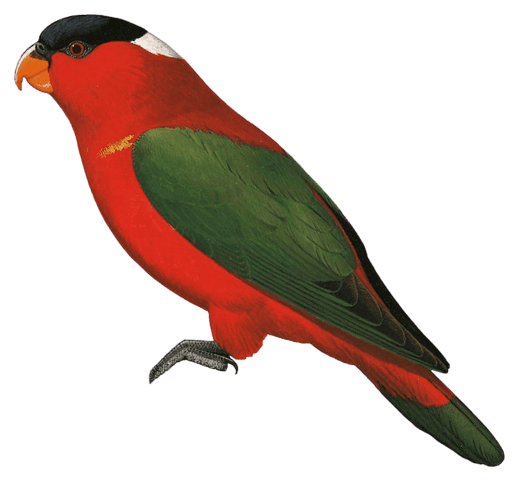
White-naped Lory
Lorius albidinuchaFAMILY
Old World Parrots (Psittaculidae)
LAST DOCUMENTED
2007
(19 years)
REGION
Oceania
IUCN STATUS
Near Threatened
Last Documented
The last documentation appears to be a July 2008 photo by Ian Reid from the island of New Ireland in Papua New Guinea.
Page Editors
- Search for Lost Birds
Species News
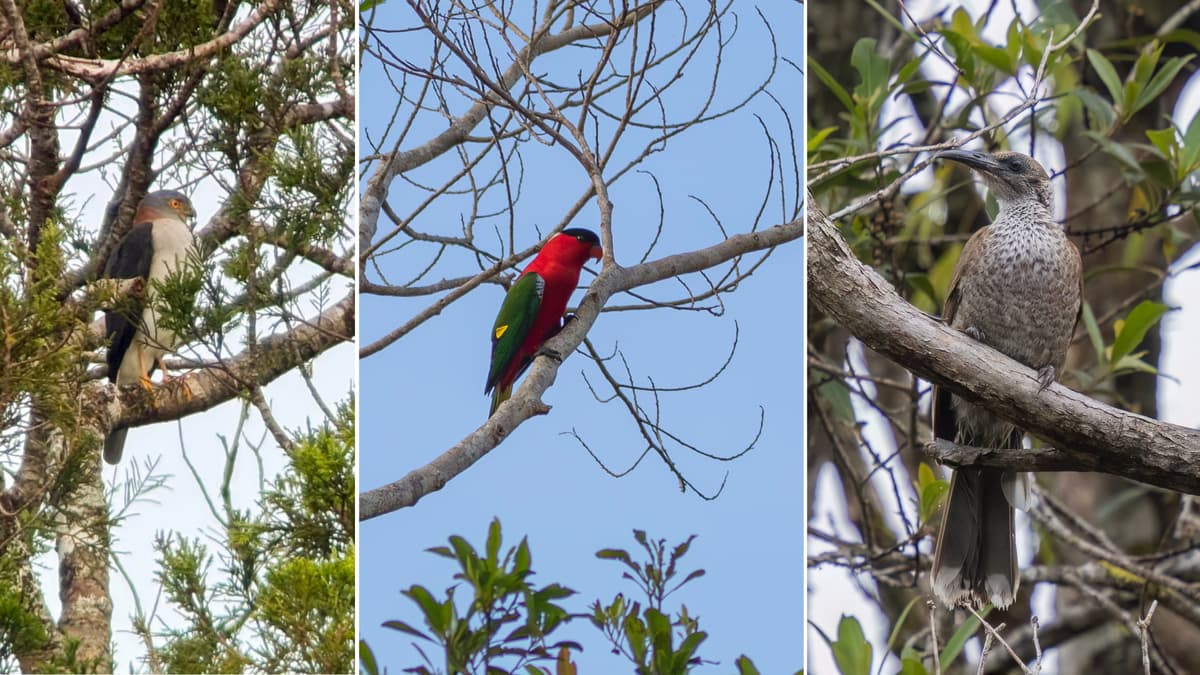
FOUND: Three lost birds rediscovered in New Ireland, Papua New Guinea, by Ornis x Lost Bird Grant Winners
John C. Mittermeier / 16 Jun 2026
Read MoreIn late April, Casper Leygraaf, Cornel Schepers, Joep Duijvestijn, and Danny Bregman — winners of one of the 2026 Ornis x Lost Birds Expedition Grants — set off to Papua New Guinea with one goal: to find the lost birds of New Ireland. Part of the Bismarck Archipelago — a group of islands off the northeast coast of Papua New Guinea — New Ireland is a thin, mountainous island home to multiple endemic and range-restricted bird species, a number of which had no documented records in the past decade or more. Over the course of the seventeen days exploring New Ireland, this team of young birders managed to find not one, not two, but three lost birds, the highest number of rediscoveries ever recorded in an expedition since the Search for Lost Birds began in 2021!
Leygraaf, Schepers, Duijvestijn and Bregman focused their expedition efforts on two sites in the Hans Meyer Range, New Ireland’s southernmost and highest mountains, enduring long travels, hikes under harsh heat, and torrential rainstorms to reach the montane forests where New Ireland’s lost birds occur. The first lost bird appeared on their very first full morning in the mountains. “We heard a parrot calling that sounded like a lory,” recounts Schepers. “Our cameras were not within reach, but less than an hour later, we heard the same calls again and this time were able to get good views and photographs.” The bird was a White-naped Lory, a brilliant red and green parrot endemic to New Ireland that had not been documented since 2008. This early success raised the team’s hope for the other lost birds.
Weather and logistics presented challenges, however. The birding team faced multiple heavy rainstorms including a huge downpour that nearly destroyed their equipment. “I am still in awe that all of our gear survived, especially our cameras and sound recorders,” recalls Leygraaf. It was not until they reached their second location in the mountains that they found the next lost bird. After starting one morning at 3 am in hopes of reaching higher elevations for dawn, their efforts were rewarded with views of a New Ireland Friarbird in the early morning. Last documented in 2012, the friarbird, like the lory, is endemic to New Ireland’s montane forests. Little did the team know that their day would get even better from there on. Exhausted, they stopped to rest later that morning when suddenly a small raptor flew silently into a nearby tree. “Danny was the only one paying attention,” recounts Schepers. “He calmly stated he saw a sparrowhawk fly into a tree in front of us. He took some shots, zoomed in, and after noticing the rufous collar, yelled: “JAAAA, DAT IS HEM! (YESSSS, THAT’S IT!)’’ Luckily, the sparrowhawk continued to sit quietly while the rest of the team and their guides, Stanley and Boni from Manga community, admired it and took photographs. One of the least-known raptors in the world, and perhaps hardest to find of the potential lost birds on New Ireland, the New Britain Sparrowhawk had last been documented in 1994.
In addition to photographing all three lost birds, the team made the first-ever sound recordings of White-naped Lory and New Ireland Friarbird, species that were among the small number of birds in the world to never be sound recorded. The expedition also resulted in records of multiple other birds with only a handful of recent observations including Beck’s Petrel, Bismarck Kingfisher, New Ireland Dwarf Kingfisher (another species that the team obtained the first ever sound recordings of), New Ireland Myzomela (last documented in 2016 and just a few months away from becoming a lost bird!), and New Hanover Munia, as well as local rarities such as the first record of White-winged Tern for New Ireland and several rarely-record endemics from Dyaul, a small island next to New Ireland. “With a couple of weeks of work, the grant team was able to generate the exact results we hoped for, and now ornithological knowledge of the Hans Meyer Range avifauna has increased dramatically,” says Joshua Bergmark, Director of Ornis Birding Expeditions.
The New Britain Sparrowhawk, White-naped Lory, and New Ireland Friarbird are respectively listed as Vulnerable, Near Threatened, and Least Concern on the IUCN Red List, and currently face threats from logging across most of their range, which has contributed to extensive habitat loss on New Ireland and neighboring New Britain. In the early 2000s, New Britain alone contributed to over half of Papua New Guinea’s total timber exports and after logging, large areas of the lowlands on both islands have now been converted to oil palm plantations.
“Few birders visit New Ireland, and those who do are primarily focused on spending a few days on just the road-accessible habitat before moving to another island,” says Bergmark. “Less than five groups have ever made it up to 1,500 m above sea level to search for birds.”
Looking back on their journey, Leygraaf suspects that the area's remoteness and the logistical challenges contributed to the sparrowhawk, lory, and friarbird going so long between documented records. “After arriving in Port Moresby, you have to take a flight to Kavieng, drive about eight hours down to the south, and then walk up a mountain for two days just to arrive at the right habitat,” he says.
One of the most important outcomes of the expedition was the connections that the team were able to make with the local landowners and communities they visited to reach the mountains. In Taron and Manga – the communities at each of the two mountain sites – people were originally surprised and a little bit skeptical about having foreigners visit their land. But after the team had explained why they were there, people warmed up and by the end of the expedition, everyone was celebrating together the success of finding the key species. With this community support, the team hopes that their findings will help encourage other birders to visit the region, contributing to ecotourism. At least one group is already imagining such a possibility—plans are in motion to visit the site in 2028 as part of one upcoming Ornis Birding tour.
“Finding three lost birds in a single expedition is truly an extraordinary accomplishment and reflects the amazing commitment and birding skills of the whole team,” says John Mittermeier, Director of the Search for Lost Birds. “It shows what is possible when you visit and spend time in places that birders overlook.”
The Ornis Birding x Lost Birds Expedition Grant is a partnership between Ornis Birding Expeditions and the Search for Lost Birds that provides grants to support young birders to undertake expeditions in search of lost birds. “We want to encourage skilled birders to spend the needed time in unusual places, and these guys have done exactly that,” says Bergmark. Submissions for the 2027 grant will be open from the 1st of July 2026 to the 31st of October 2026.
Read the team’s first-hand account of their experience on the Ornis website and see their eBird trip report with photographs and sound recordings of all the species encountered.
Edidiong Daniel has a background in environmental management and toxicology with interests in the human dimensions of conservation, particularly human behaviour change. She is big on storytelling for science communication.
Support The Search for Lost Birds
Donations from supporters like you make expeditions, science, and conservation possible. Help support the Search.