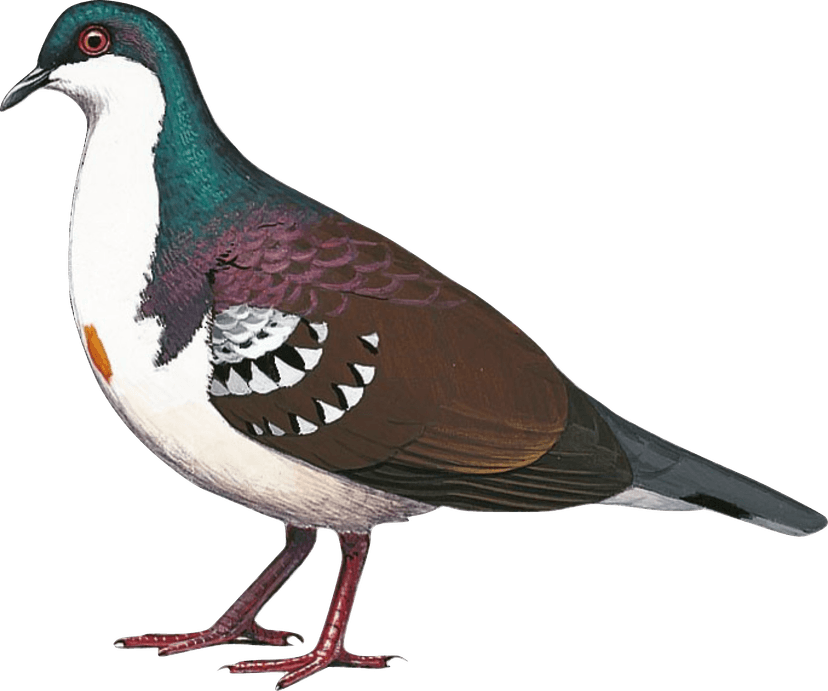
Mindoro Bleeding-heart
Gallicolumba platenaeFAMILY
Pigeons and Doves (Columbidae)
LAST DOCUMENTED
2005
(21 years)
REGION
Asia
IUCN STATUS
Critically Endangered
Background
This Critically Endangered pigeon was lost for 20 years between December 2005 and August 2026, when it was rediscovered as part of a project led by the Center for Conservation Innovations (CCIPH) in collaboration with the indigenous Iraya Mangyan communities on Mindoro island, Philippines.
The Mindoro Bleeding-heart is found only on Mindoro where it is threatened by habitat loss and hunting. It is one five species of bleeding-heart pigeons in the world, all of which are endemic to the Philippines. Along with the Mindoro Bleeding-heart, the Sulu Bleeding-heart is also a critically endangered lost bird and was last documented in 1890.
Last Documented
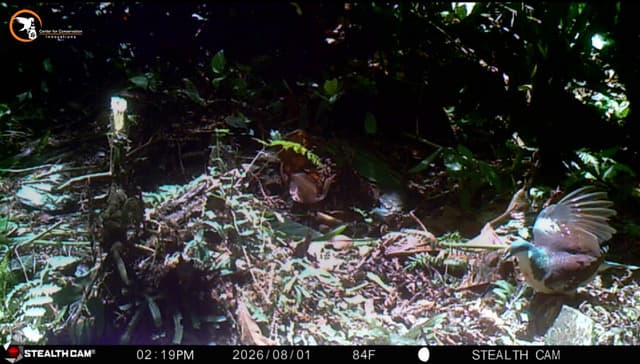
Mindoro Bleeding-heart was rediscovered on 1 August 2026 when a single individual was documented on a camera trap in forest above 900 m in Mindoro. An full account of the rediscovery is available on the CCIPH website: A Heart That Still Beats: The Rediscovery of Mindoro’s Rarest Bird.
Prior to 2026, the last documented record of Mindoro Bleeding-heart was a series of photographs of an individual that was captured and released near the Sablayan Prison in December 2005.
A 2016 sound recording archived on Xeno-canto could be Mindoro Bleeding-heart but is currently considered uncertain. The recording is difficult confirm since the bird was not seen and there are no known recordings of Mindoro Bleeding-heart to compare it to.
Page Editors
- John C. Mittermeier
Species News
FOUND: Critically Endangered Mindoro Bleeding-heart Rediscovered After More Than 20 Years
John C. Mittermeier / 3 Sep 2026
Read MoreResearchers in the Philippines have captured photographs of the Mindoro Bleeding-heart, a beautiful and Critically Endangered species of ground-dwelling pigeon found only on the Philippine island of Mindoro. In August 2026, a single bleeding-heart was documented on a camera trap as part of a project led by the Center for Conservation Innovations (CCIPH) in collaboration with the indigenous Iraya Mangyan communities on Mindoro.
You can read the full story of the incredible rediscovery on the CCIPH website: A Heart That Still Beats: The Rediscovery of Mindoro’s Rarest Bird.
Prior to this, the last definite documented record of a Mindoro Bleeding-heart was a series of photographs of an individual captured near Sablayan Prison in December 2005. A possible sound recording from 2016 could be a bleeding-heart, but the identification remains uncertain and difficult to prove in the absence of any known recordings of the species.
The Mindoro Bleeding-heart was once a common species in Mindoro’s lowland forests but in the past century most of the bird’s lowland forest habitat has been cleared. Records of the bleeding-heart declined precipitously in second half of twentieth century before stopping entirely after 2005. In interviews, local people often reported that they had not seen the species in years. For many in the conservation world, hope for the bird was running out.
The new photographs provide a burst of optimism and confirm that the Mindoro Bleeding-heart still holds on. Now comes the challenge of how to conserve this newly-found species. As the rediscovery team describe, a top priority will be protecting and restoring the forest where the bird was found, something that will only be possible through continued collaboration between scientists and indigenous communities.
From a Search for Lost Birds perspective, the Mindoro Bleeding-heart is the just third Critically Endangered lost bird to be rediscovered since 2022 (the others are Black-naped Pheasant-pigeon and Santa Marta Sabrewing), a fact that highlights just how spectacular this recent rediscovery is. Could some of the other Critically Endangered species on the lost birds list also be out there waiting to be rediscovered? We certainly hope so.
Support The Search for Lost Birds
Donations from supporters like you make expeditions, science, and conservation possible. Help support the Search.