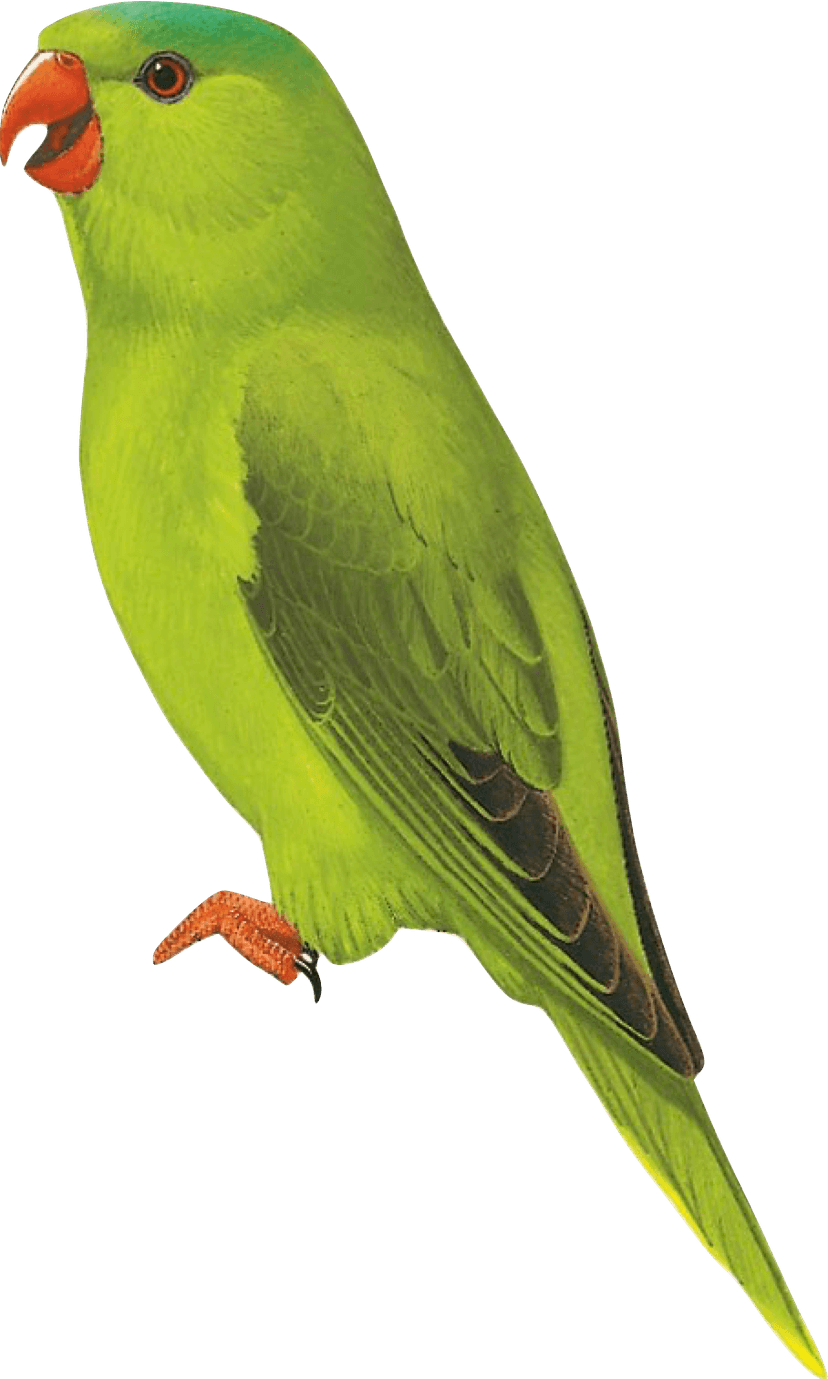
Blue-fronted Lorikeet
Charmosynopsis toxopeiFAMILY
Ducks, Geese, and Waterfowl
LAST DOCUMENTED
2014
(12 years)
REGION
Asia
IUCN STATUS
Data Deficient
Background
Endemic to the island of Buru, Indonesia, this small lorikeet was described from a series of seven specimens collected in the 1920s. Following these initial records, it was lost for nearly 90 years before being photographed in 2014. It has not been documented again since.
Conservation Status
As of the 2024, the Blue-fronted Lorikeet is listed as Data Deficient, reflecting how little in known about the species. Prior to this, it was considered Critically Endangered based on the assumption that it must have a small, and perhaps declining, population due to how rarely it has been recorded.
Last Documented
The last documented record, and only known photographs of Blue-fronted Lorikeet, were taken by Craig Robson in 2014.
Page Editors
- Search for Lost Birds
Species News
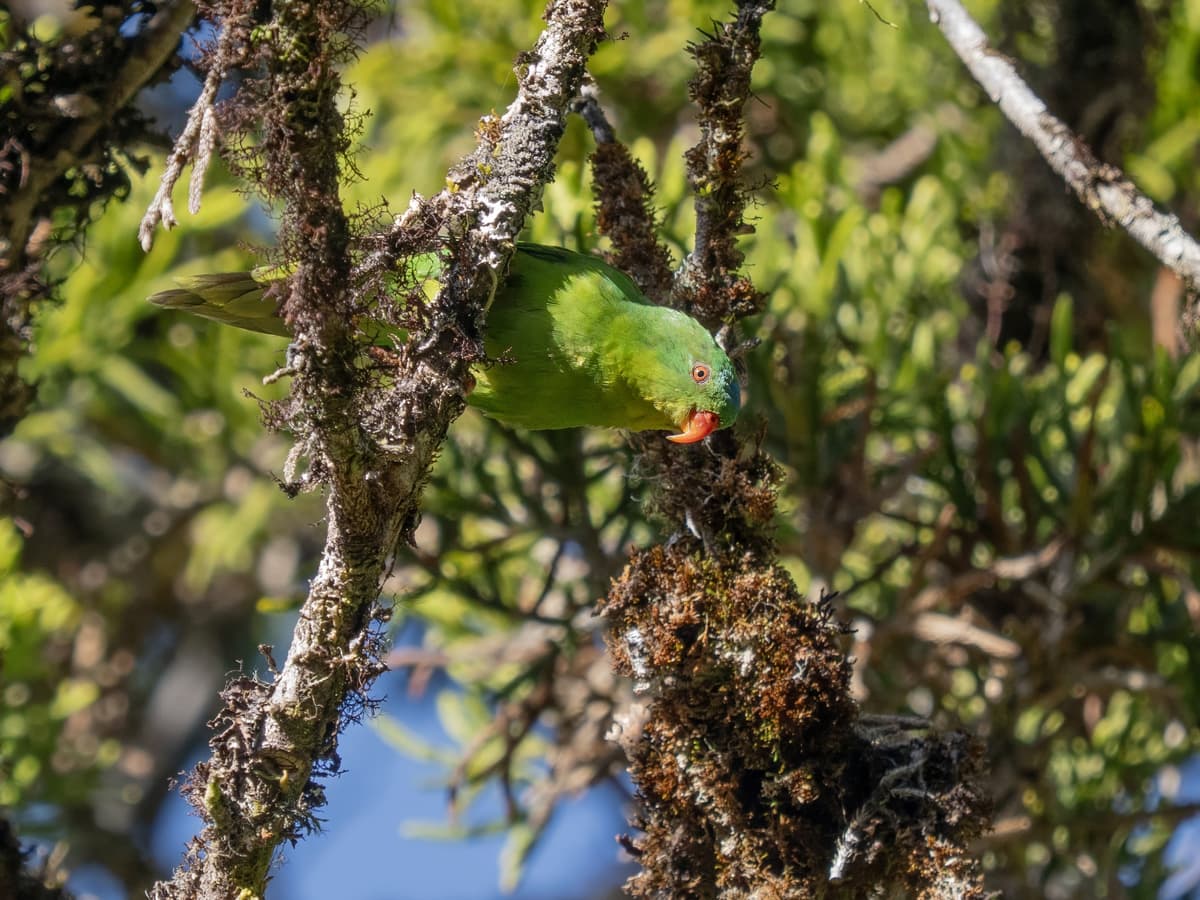
FOUND: Blue-fronted Lorikeet Documented in Buru's Remote Highlands
John C. Mittermeier / 3 Jun 2026
Read MoreThe montane forests of Buru, Indonesia sit behind a natural barricade of jagged limestone, rattan thorns, and biting insects. Last fall, local climbers with the Wanadri Mountain and Jungle Explorer Association mapped a new route to the island’s highest peak, a 2,700-meter summit long considered unreachable. In April, another team followed in their footsteps, but with an additional goal in mind.
Led by Indonesian mountaineering group Kanal Buru and expedition leader Handoko, four travelers ventured to the highlands of Mount Kapalatmada: Sumaraja, Birdtour Asia guide and tour leader; Adam Miller of Yayasan Planet Indonesia; James Eaton, also of Birdtour Asia and lead author of Birds of the Indonesian Archipelago; and John Mittermeier, Director of the Search for Lost Birds at American Bird Conservancy. What they found near the summit made every hardship of the trek worthwhile. Blue-fronted Lorikeets flitted through the flowering canopy — an endemic species documented only once in the last hundred years.
A Century of Silence
The Blue-fronted Lorikeet was first described from seven specimens collected in the 1920s. Soon after, the bird disappeared from the scientific record. Despite extensive surveys in the lowland and mid-elevation forests tied to the original specimens, the parrot went undetected for decades.
The lack of observations created uncertainty around the bird’s conservation status. The IUCN Red List listed the lorikeet as Critically Endangered in 2000, interpreting its long silence as evidence of a small, possibly declining population. Then in 2024, the lorikeet was reclassified as Data Deficient, an admission that with so little knowledge of the lorikeet’s population size, trends, or distribution, it was impossible to accurately assess its extinction risk.
“Rare sighting records suggest a highly restricted habitat use,” said Benny A. Siregar, Maluku Coordinator at Burung Indonesia. “The primary challenge facing the Blue-fronted Lorikeet is that they are facing threats that remain largely unknown. This bird inhabits areas under continuous pressure from deforestation, with a population estimated to be exceedingly small and vulnerable.”
Even if the exact threats remain unknown, there are a number of potential risks to the lorikeet’s survival. Surveys conducted by the Konservasi Kakatua Indonesia (KKI) from 2023 to early 2025 documented extensive habitat destruction by logging companies in areas at elevations of 500-1,200 meters above sea level and found that local people in the mountains continue to hunt birds for consumption and trade. Several parrot species were among those hunted including the Great-billed Parrot, Moluccan King-Parrot, Red Lory, and Buru Racquet-tail.
In 2014, a handful of photographs taken by Craig Robson and a Birdquest birding tour confirmed that the Blue-fronted Lorikeet was still alive, but the sighting raised more questions than answers. Why had no one seen it again? Why were the records so sparse? Ten years later, the species cycled onto the lost birds list.
Many suspected that the lorikeet had simply been living at higher elevations, in Buru’s never-surveyed montane forests. The idea remained untested until access to the highlands finally made exploration possible.
Into the Highlands
Led by Handoko and members of Kanal Buru, the team set off on April 11 for a 14-night trek. Their route cut through some of Indonesia’s most challenging terrain, a grueling scramble over uneven, slippery rocks and steep boulders that shifted underfoot. Plants sliced at their skin and biting ants seemed to position themselves on every handhold.
On the sixth day of climbing, the landscape changed. The trail opened into a mossy cloud forest, then a rolling, park-like clearing alive with birdsong. They had reached the highland plateau of Mount Kapalatmada.
Within hours, the lost lorikeet appeared. The team noticed two small birds fly into a nearby tree. After only glimpsing the birds in flight, John raised his binoculars expecting to see a honeyeater. Instead, his eyes landed on a lime-green parrot with an orange bill and blue forecrown. “I short-circuited with excitement,” he recalls. The birds left before anyone could capture a photograph, but the fleeting encounter confirmed their suspicions: the lorikeet had been waiting in the highlands all along.
“When we saw the Blue-fronted Lorikeet, I couldn’t hold back my tears,” says Sumaraja. “Every day, I almost cried with joy at discovering that these birds still exist.”
Two days later, on April 18, another lorikeet flew into the mossy canopy of a nearby tree while the group gathered for breakfast. Even without binoculars, they could see its bright green color glistening in the morning sun. The lorikeet paused for a few seconds before flying off again and vanishing into the forest. It was just long enough to snap a few photographs marking the first documentation of the lorikeet in over a decade.
With that, the team had the first documented record of Blue-fronted Lorikeet since 2014, and only the second confirmed observation in a century. Still, they hoped for another opportunity to observe and record the elusive parrot. As the days slipped by without another sighting, they questioned whether the moment would ever return.
On April 21, their final morning in the highlands, the group headed to a narrow clearing where birds funneled between flowering trees. There, darting back and forth across the gap, were the lorikeets — like little green bullets with long wings and a short, pointed tail. As the birds sped between the trees, they made the first sound recordings of the lorikeet’s high-pitched calls. At last, they spotted a pair perched in the canopy above them. After 10 days of searching, they finally had the views of the Blue-fronted Lorikeet that they had dreamed of.
Taken together, these observations provide definitive proof that the Blue-fronted Lorikeet persists in Buru’s highlands.
Beyond the Lorikeet
The lorikeet wasn’t the only surprise waiting on the plateau. On their first day in the highlands, the team also encountered a Madanga, one of Indonesia’s most unusual songbirds. The bird’s song caught their attention, a repetitive series of high-pitched trills. After recording the voice and playing it back, the team located its source: a tiny Madanga sitting atop a giant tree.
Long thought to be a type of white-eye, the Madanga was revealed through genetic sequencing to be an arboreal pipit. The bird is a taxonomic oddity, its placement within the pipit lineage not easily explained. But as the group watched it forage and sing from the highest treetops, the evolutionary connection became clearer. “The song was like a pipit. Singing from treetops is so pipit-esque, which is quite mind-blowing when all previous observations of this bird were of it feeding in the low- to mid-story,” James reflects. Their recordings and observations shed new light on the forest bird’s puzzling link to its grass-dwelling relatives.
After the Madanga and Blue-fronted Lorikeet, the plateau offered yet another exciting find. The group heard a familiar call and traced it to an ‘Island Thrush,’ unrecorded on the island but expected in its upper montane forests, a habitat the bird favors elsewhere in the region. But this individual looked nothing like the grey thrushes of Seram or Taliabu. Instead, it was glossy and black, with a bright orange eye ring and bill — certainly an undescribed taxon. Around camp, the thrushes were abundant, giving the team ample opportunity to observe and photograph them.
What Comes Next
The rediscovery of the Blue-fronted Lorikeet brings us one step closer to understanding one of the world’s most enigmatic parrots. “Our conclusion is that the hypothesis of lorikeets being restricted to these high-elevation habitats is probably true,” John explains. “They are an insanely cryptic and challenging bird, and very easy to miss.”
The finding also carries broader implications. Several other small island lorikeets, including the lost New Caledonian Lorikeet and Red-throated Lorikeet, are feared to be on the brink of extinction. Finding one species alive in a remote montane refuge offers hope for others.
The Madanga and Island Thrush discoveries underscore the importance of Buru’s montane forests, which remain almost wholly unexplored. Once unreachable, the pristine highlands are now a site for discovery and possibility. In just two weeks, the team uncovered new records of the Blue-fronted Lorikeet, new songs of the Madanga, a new Island Thrush taxon, and a new island record of Meyer’s Goshawk, one of the most elusive raptor species in the world.
Until now, the inaccessibility of Mount Kapalatmada’s highlands has served as their greatest protection. With a new route to the summit, however, the future of this habitat depends on thoughtful stewardship and collaboration with the people who know the mountain best.
“There is a need for a collective approach and action from all stakeholders to protect the remaining habitat of this incredible bird,” says Dwi Agustina, Conservation Program Coordinator for KKI. “Buru is home to many endemic birds, and the logging and mining companies that have acquired much of the island’s forest represent a major threat to the survival of the Buru’s birds and wildlife.”
Handoko reflects: “This expedition helped me and the members of Kanal Buru gain new perspectives and knowledge about Mount Kapalatmada, especially about the birds and the ecosystems there. I hope to share these experiences to empower people in Buru to protect this unique area.”
“In the future, I certainly hope more people will be able to see and learn more about these birds,” Sumaraja says. “At the same time, I sincerely hope more people will care about and participate in preserving the remaining forests on Buru Island.”
Nina Foster is a science communication specialist with interests in ornithology, forest ecology, and sustainable agriculture. She holds a BA in English literature with a minor in integrative biology from Harvard University and is currently an environmental educator at Schoodic Institute at Acadia National Park.
Support The Search for Lost Birds
Donations from supporters like you make expeditions, science, and conservation possible. Help support the Search.