Molly Bergen / 29 Jul 2026 / Mayr's Forest Rail
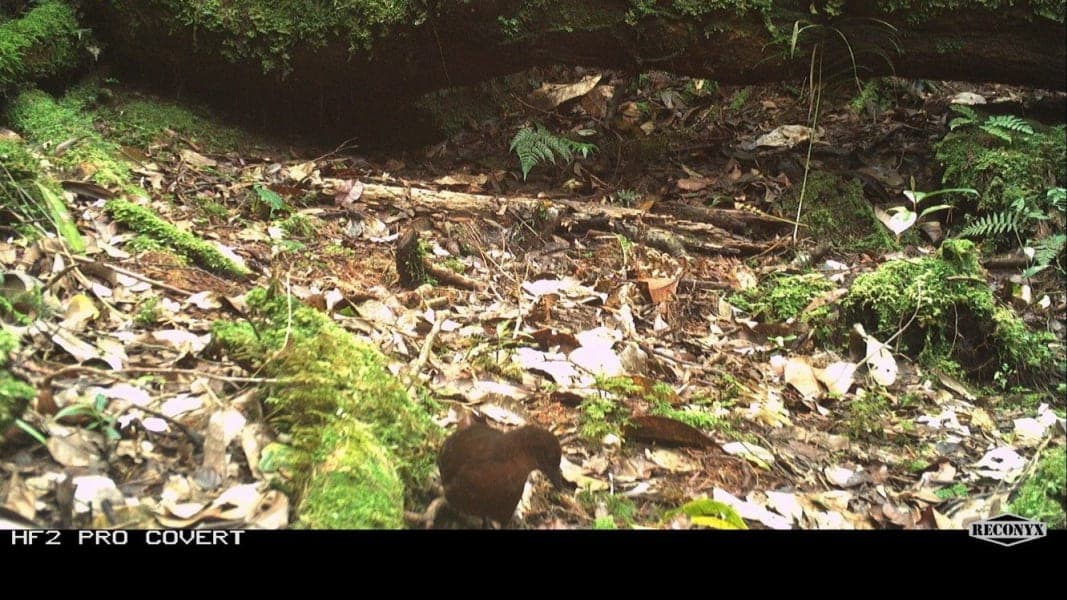
In Indonesia’s Cyclops Mountains, the Mayr’s Forest Rail was recently rediscovered thanks to a camera-trapping expedition, which has given scientists new insights into the wildlife hidden in a nearly impenetrable forest. The ground-dwelling bird was last spotted in Papua’s Foja Mountains 18 years ago, and this is the first time it’s been scientifically documented in the Cyclops Mountains since Ernst Mayr first described the species in 1928.
The reappearance of the Mayr’s Forest Rail marks the third documented rediscovery from the 2023 expedition so far, following the Attenborough’s Long-beaked Echidna, an egg-laying mammal that is endemic to these mountains, and the Mayr’s Honeyeater, a bird that hadn’t been documented since 2008. These discoveries, plus others from the expedition that have yet to be released, underscore just how much life the Cyclops Mountains hold — and why the region must be protected before it’s too late.
Camera Traps Provide New Insights
The world’s second-largest island after Greenland, New Guinea is also the most biodiverse, and it is especially famous for its abundant bird life. The island is home to about 780 bird species, nearly half of which are endemic to New Guinea and its satellite islands.
Although a lot is still unknown about the whole island, the Indonesian side of the island remains especially mysterious — particularly in the Cyclops Mountains of northeast Papua, which were formed when volcanic islands collided with the northern margin of New Guinea around 10 million years ago.
“There are many interesting scientific questions about whether that movement and collision and creation of mountains has provided an environment for new species to diversify, and whether that's contributed to the exceptional biodiversity of New Guinea,” says Dr. James Kempton, a biologist currently with the Royal Botanic Gardens, Kew, who took part in the expedition.
In the past, scientific research in the Cyclops has been limited largely due to its inaccessibility. “It's extremely rugged, extremely steep,” says Malcolm Kobak, cofounder and managing director of local NGO YAPPENDA who led the logistics side of the expedition. To reach the remote field sites, the team “drove for over two hours in a 4x4 before an extremely difficult hike into the mountains.”
Other challenges can hinder species documentation once researchers arrive at the survey site. Birds such as parrots or birds of paradise may be relatively easy to spot in the tree canopy, but the dense vegetation closer to the ground makes other species hard to find. “The birds down in the undergrowth are often more elusive and harder to see,” says Kobak. “For example, there's a bird that I know from my area — I have heard the bird sing, I have seen glimpses of it in the bush, but I have never been able to identify the bird. That's where camera traps are so valuable.”
The Expedition Cyclops team—which was led by YAPPENDA and included students from Cenderawasih University, and biologists from the University of Oxford, Mendel University in Brno, Royal Holloway University in London, and Re:wild, spent weeks making trails through the forest, battling malaria, infections, leeches and other tropical hazards to set up the cameras at a range of elevations between lowland forest and mountain summits. While the rediscovery of the Attenborough’s Long-beaked Echidna was a primary goal, researchers also set up camera traps in places where they believed that they would be most likely to find other species, such as prime perching branches in the thick scrub alongside rivers.
Kobak credits Yongsu Sapari, the local Indigenous community with making the expedition a success.
“These people have lived in these spaces in a relationship that's been forged over thousands of years, and we had their blessing going into the field” he says. “They know that landscape better than anyone, so they were able to help us find good animal trails, good trees, and other appropriate places to set up cameras.”
Over about nine months, the camera traps took over 38,000 images — including six of the Mayr’s Forest Rail, which was an unexpected find. As it has so rarely been seen, little is known about the species’ ecology or the size of its remaining population.
Supporting Local Communities’ Fight for Forest Protection
“These discoveries are a reminder of the biodiversity but also the fragility of these ecosystems,” Kobak says.
As of 2018, over 83% of Indonesian Papua was still covered in primary forest. However, the global demand for palm oil and other resources found in these forests is driving an increase in palm oil and sugarcane cultivation, and mining—including in peat forests, which play a major role in sequestering carbon.
To help protect the forests and the rights of all who live there, YAPPENDA is supporting local Indigenous communities in their fight to secure land tenure over the places where they’ve lived for generations, as well as developing a local conservation outreach strategy based on sharing and preserving cultural traditions tied to nature—such as the perception of certain species, including tree kangaroos and echidnas, as sacred.
“As young people go off looking for jobs in cities, they lose connection with their culture, they lose the language,” Kobak says. “So, it's important to hold on to these important cultural traditions that are tied to their landscape.”
Molly Bergen is a Washington, D.C. , - based writer and editor specializing in conservation storytelling. Drawing on more than 16 years of experience writing about wildlife, climate change and community-based conservation, she helps organizations spotlight environmental solutions and encourage actions needed to protect and restore our planet.